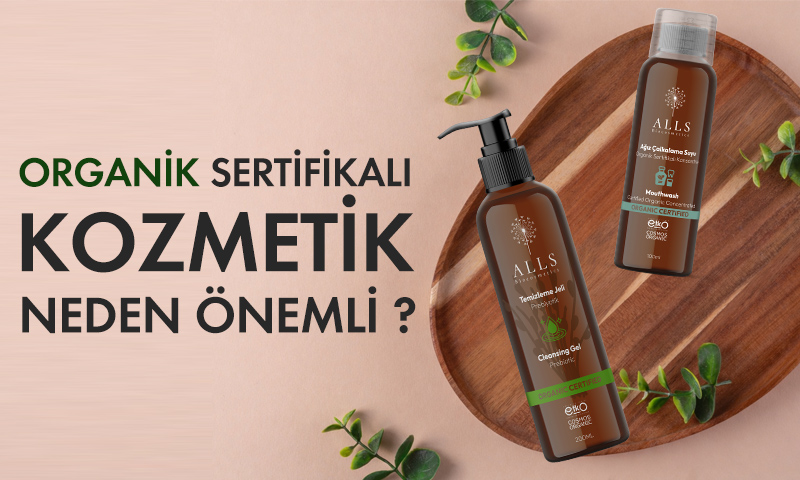
Why Is Organic Certified Cosmetics Important?
The “Silent” Dimension of Lifelong Exposure
Contents
- Why Are the Products We Use Every Day More Critical?
- What Does “Organic Certified Cosmetics” Mean?
- What Standards Does the COSMOS Organic Certification Indicate?
- From Raw Materials to Production: How Does the Audit Chain Work?
- Packaging and Sustainability
- Alls Biocosmetics’ Approach
- A Practical Selection Guide for Consumers
- Frequently Asked Questions
Why Are the Products We Use Every Day More Critical?
Cosmetic products are not only used on special occasions. On the contrary, they are regularly present in almost every stage of life from birth onward. Examples include washing hands, cleansing hair, performing oral care, taking a shower, and cleansing the skin.
These contacts are often not limited to a single area. Some products are applied to multiple areas throughout the day, while others are used over a large surface of the body. For this reason, when evaluating cosmetic products, frequency of use and the area of contact form an important context.
The Most Commonly Used Cosmetic Products
- Liquid hand soaps, shower gels, shampoos
- Toothpastes and oral care products
- Skin cleansers, toners, makeup removers
- Lip balm, hand care cream, body care products
- Daily care products for mothers and babies
- Moisturizers applied to large surface areas
At this point, the difference between products used occasionally and those used daily and regularly becomes more apparent.
Alls Biocosmetics’ approach is also based on this distinction. Products that are part of a daily routine should be evaluated with ingredient transparency and auditable production processes as a standard.
What Does “Organic Certified Cosmetics” Mean?
In the cosmetics world, terms such as “natural,” “clean,” and “plant-based” are frequently used. However, these descriptions do not always represent the same level of oversight or the same set of criteria.
An organic certification indicates that a product has been audited by a third-party body according to specific standards covering areas such as raw material sourcing, formula composition, production processes, documentation and traceability systems, and labeling practices.
A certification points to a documented and auditable process rather than a claim.
What Standards Does the COSMOS Organic Certification Indicate?
Under the COSMOS framework, two main designations are encountered: COSMOS ORGANIC and COSMOS NATURAL.
Why Can Organic Ratios Vary Depending on the Product Type?
In some product categories (especially rinse-off products), water makes up a large portion of the formula.
Plant-Based Ingredients
Within the scope of COSMOS Organic, plant-derived ingredients are expected to be obtained from organic farming.
From Raw Materials to Production: How Does the Audit Chain Work?
What makes an organic certification meaningful is not only the label on the final product, but the documentation and traceability system behind it.
Packaging and Sustainability
Evaluating organic certified cosmetics solely based on their ingredients creates an incomplete perspective.
Alls Biocosmetics’ Approach
Alls Biocosmetics aims to bring the philosophy of organic certified cosmetics into everyday life.
A Practical Selection Guide for Consumers: How to Read the Label?
- Review the certification logo
- Evaluate organic ratios within the product context
- Start with the products you use most frequently
- Follow the instructions for use
Frequently Asked Questions
This content is for general informational purposes only. Cosmetic products do not treat diseases.